 By
By 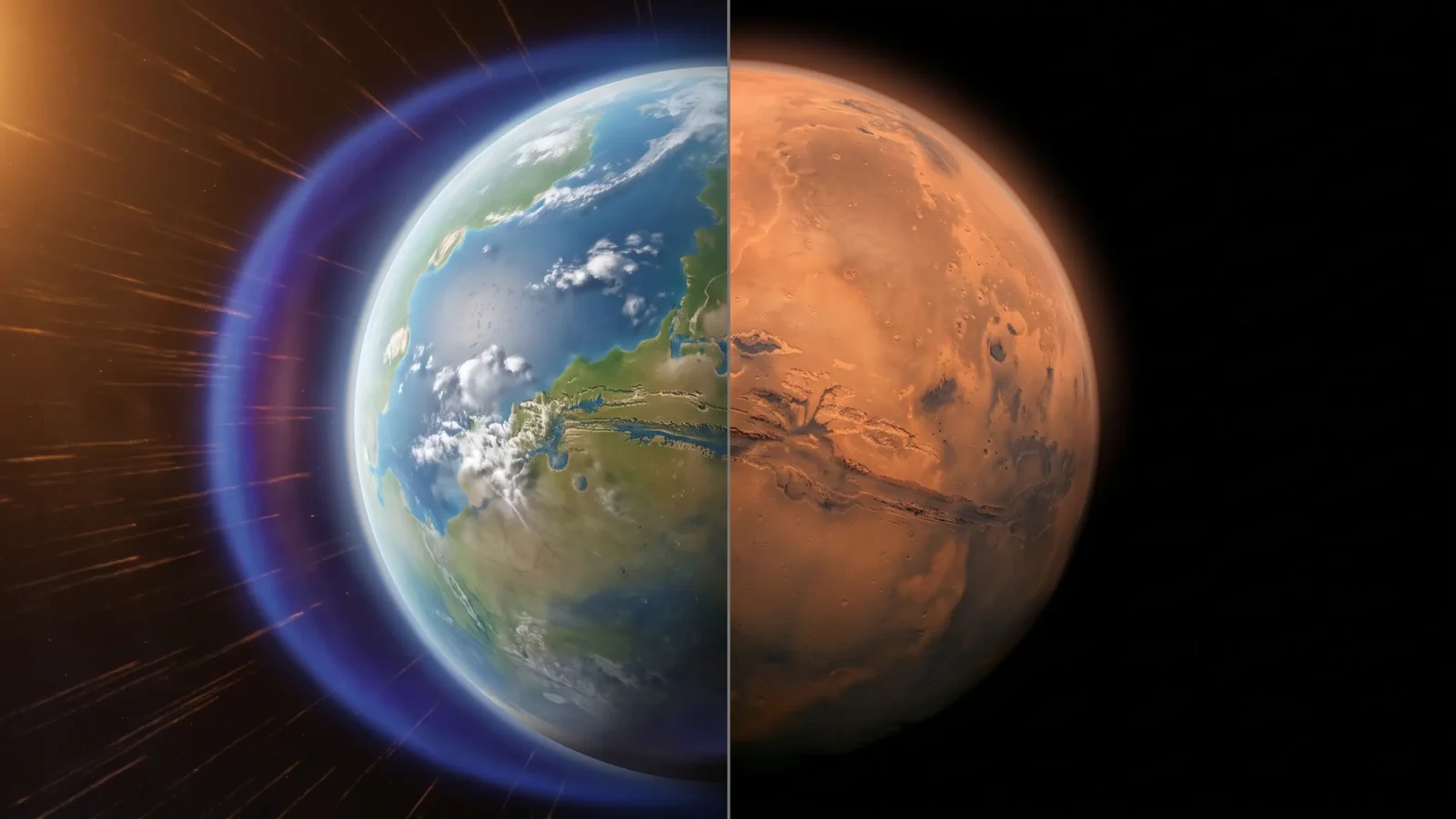
Quick Answer
Mars lost its atmosphere because it lost its global magnetic field. When Mars’ core cooled and its protective magnetic shield switched off around four billion years ago, the solar wind — a stream of charged particles from the Sun — slowly stripped away the planet’s once-thick air, molecule by molecule, over billions of years. What was once a warm, wet world became the cold, dry desert we see today, with an atmosphere less than 1% as dense as Earth’s.
Mars is a planetary cautionary tale: proof that a world much like the early Earth can have its air torn away and its oceans freeze. Understanding how Mars died tells us a great deal about what keeps our own planet alive. This guide explains what happened to the Martian atmosphere, the role of its vanished magnetic field, and what the MAVEN mission discovered about the slow suffocation of the Red Planet.
What Mars’ Atmosphere Is Like Today
The modern Martian atmosphere is thin, cold, and unbreathable. It is composed of about 95% carbon dioxide, with small amounts of nitrogen and argon, and the surface pressure averages only around 0.6% of Earth’s at sea level. That is so thin that liquid water cannot remain stable on the surface, and a human without a pressure suit would not survive — body fluids would begin to vaporise.
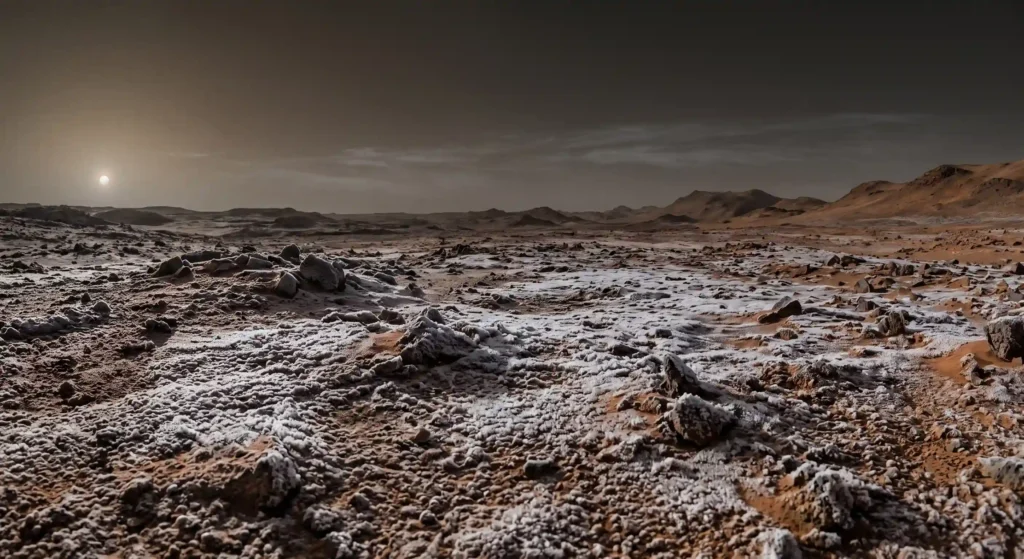
Average temperatures hover near −60°C, swinging wildly between day and night because the wispy air holds almost no heat. Despite its thinness, this atmosphere still produces clouds, dust storms that can engulf the entire planet, and seasonal frost. But it is a ghost of what Mars once had.
How We Know: The Isotope Fingerprint
Before getting to the mechanism, it is worth asking how anyone can be confident Mars ever had a thick atmosphere at all. The answer does not come from the riverbeds — those show water, not air. It comes from a subtle chemical signature that only atmospheric escape can produce.
When gas leaks from the top of an atmosphere into space, lighter atoms escape more easily than heavier ones. Over billions of years this preferentially removes the light isotopes and leaves the heavy ones behind, gradually skewing the ratio. That skew is a fossil record of loss, readable today with a mass spectrometer.
- Argon. The ratio of argon-38 to argon-36 in the Martian atmosphere is markedly enriched in the heavier isotope compared with the solar system baseline. Argon is chemically inert, so it cannot have been removed by reactions with rock — it can only have escaped to space. This makes it the cleanest possible tracer.
- Hydrogen. Mars’ atmosphere holds roughly five to six times more deuterium relative to ordinary hydrogen than Earth’s does. Since hydrogen comes overwhelmingly from split water molecules, this measures how much water has been lost.
- Nitrogen. Nitrogen-15 is similarly enriched relative to nitrogen-14, telling the same story for a third independent element.
Three different elements, three independent measurements, one conclusion: Mars has lost a very large fraction of its original volatile inventory to space. The isotopes rule out the alternative explanation that the atmosphere was never there in the first place.
The Magnetic Field Mars Lost
Early Mars almost certainly had a global magnetic field, generated deep inside the planet much as Earth’s is today. We know this because spacecraft have detected strong “fossil” magnetism locked into the oldest regions of the Martian crust — a permanent record of a field that has since vanished. That field was Mars’ invisible shield, deflecting the charged particles of the solar wind before they could reach the atmosphere.
How a dying core killed the magnetosphere
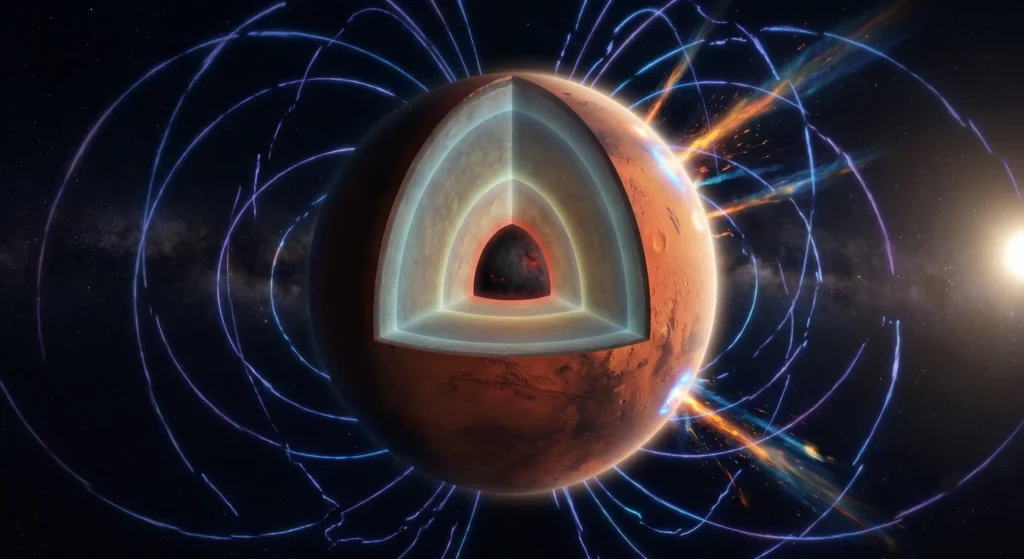
A planet generates a global magnetic field through a dynamo: the churning of molten, electrically conductive metal in its core. Mars is only about half Earth’s diameter, so it cooled far faster. As its core lost heat, the convection that powered the dynamo weakened and then stopped, roughly four billion years ago. With the dynamo dead, the global magnetic field collapsed — and the atmosphere was left exposed. The same machinery still runs inside Earth, as explained in our article on how Earth’s magnetic field works.
How the Solar Wind Stripped the Air Away
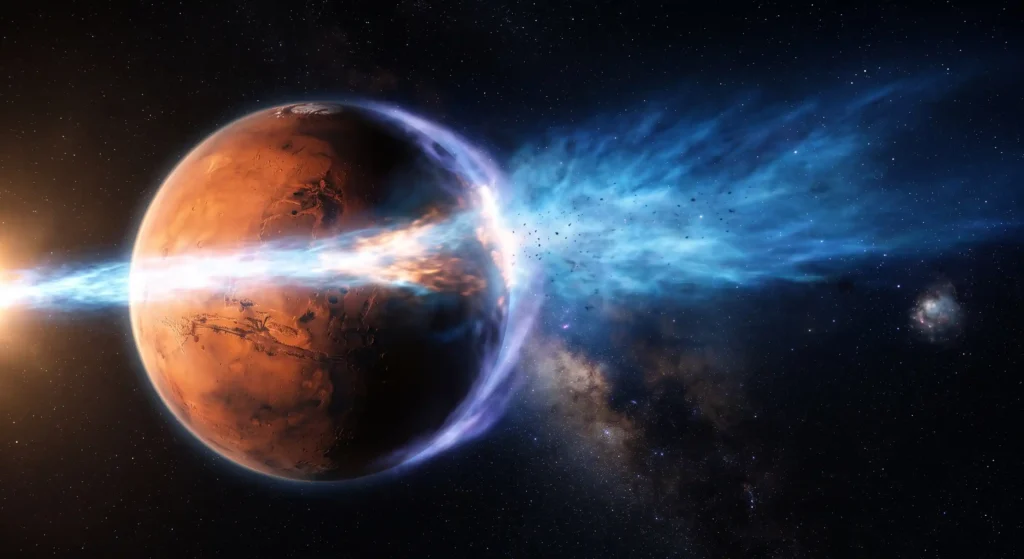
The Sun constantly blows out a stream of charged particles called the solar wind. On Earth, our magnetic field channels this wind around the planet. On Mars, with no global field to stop it, the solar wind slammed directly into the upper atmosphere. There, it energised gas molecules and carried them off into space through several processes: charged particles were “picked up” and dragged away, and impacts knocked neutral atoms out in a process called sputtering.
This stripping was not a single dramatic event but a slow bleed over billions of years. Crucially, the young Sun was far more active than it is today, with a stronger solar wind and more intense radiation, so the early loss rate was much higher. Bit by bit, Mars exhaled its atmosphere into the void, and as the air thinned, the greenhouse warming it provided faded — letting the planet freeze.
The Five Ways a Planet Loses Its Air
“The solar wind stripped it” is a useful summary of several distinct physical processes, each with its own signature and each dominant at a different stage of Martian history. Separating them is how researchers reconstruct the sequence.
- Jeans escape (thermal). In any gas, some molecules in the high-speed tail of the distribution exceed escape velocity and simply leave. Because it depends on molecular mass, this affects hydrogen strongly and heavier species almost not at all. It is why Mars, with an escape velocity of just 5 km/s against Earth’s 11.2, could never hold light gases well.
- Photochemical escape. Ultraviolet light and charged particles split molecules apart, and the fragments recoil with enough energy to escape. When carbon dioxide is broken up, the resulting oxygen atoms can be flung away. This is thought to be the dominant loss channel for oxygen on Mars today.
- Ion pickup. Solar ultraviolet ionises atoms in the upper atmosphere; the solar wind’s magnetic field then grabs those charged particles and carries them off directly. Mars loses gas along a visible plume in the anti-solar direction through this route.
- Sputtering. Heavy ions accelerated back into the atmosphere collide with neutral atoms and knock them clean out — like a cannonball into a pool. Uniquely among these processes, sputtering can remove heavy species that thermal escape cannot touch, which is why it is implicated in the loss of carbon dioxide itself.
- Impact erosion. Large asteroid impacts during the early solar system blasted portions of the atmosphere directly into space. This was probably significant in the first few hundred million years and negligible since.
The picture that emerges is sequential rather than simultaneous. Impact erosion and rapid thermal escape dominated the earliest era. Once the dynamo failed, ion pickup and sputtering took over as the primary drains, running hardest while the young Sun was most violent and slowing steadily as it calmed. What remains today is the residue of a four-billion-year process that has now nearly run out of material.
2025: Sputtering Caught in the Act
Sputtering was the last major mechanism to be confirmed by direct observation rather than inference, and it took nine years of data to do it.
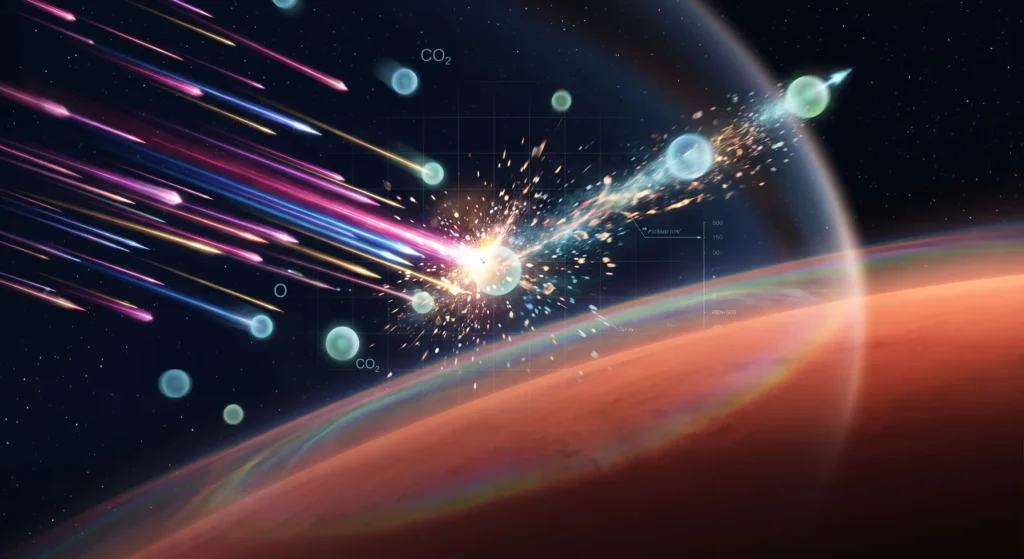
The difficulty was that sputtering happens at high altitude, is intermittent, and produces the same end result as other escape processes. Distinguishing it required finding a signature no other mechanism could produce. In 2025, a team analysing nearly a decade of MAVEN measurements found one, using argon as the tracer.
The method was elegant. Argon is chemically inert, so its behaviour reflects physics alone. The researchers compared argon densities at high altitude — around 350 kilometres — with densities near the surface, and correlated them against the orientation of the solar wind’s electric field, which controls where sputtering ions strike. Near the ground, argon density stayed essentially constant. High up, it varied systematically with the solar wind geometry, and the lighter argon isotope was preferentially depleted exactly where the model predicted sputtering should be strongest. Published in Science Advances, this was the first direct detection of atmospheric sputtering at Mars.
The result carried a surprise. The measured sputtering rate came out more than four times higher than existing models predicted. The team also caught the process during a solar storm and observed it intensify sharply — a direct window onto conditions when the young Sun was far more active.
Both findings push the same direction: atmospheric escape at Mars has been more efficient than assumed, which strengthens the case that space loss, rather than burial in rock, accounts for the bulk of the missing atmosphere.
The MAVEN Mission’s Findings
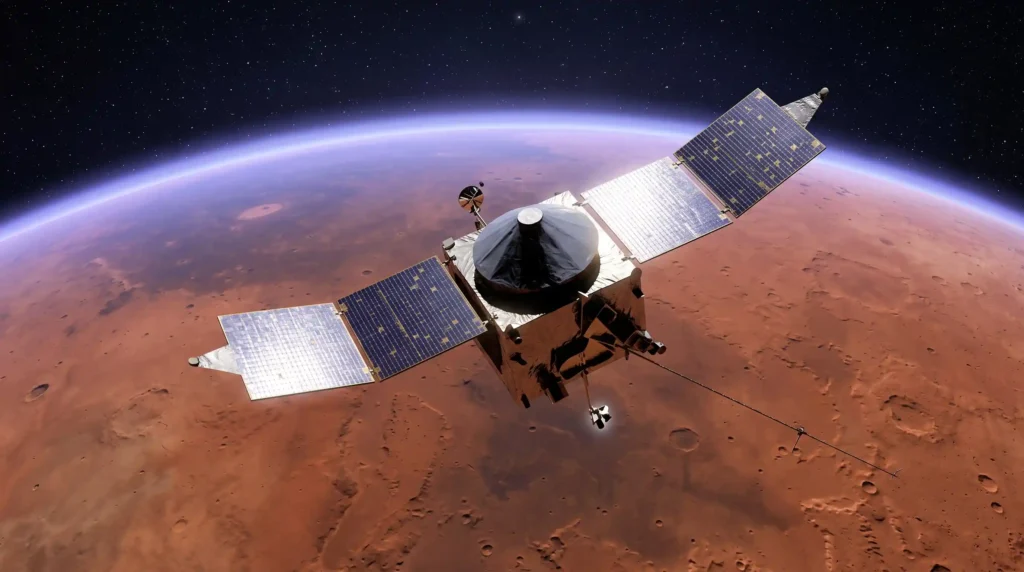
To measure this process directly, NASA sent the MAVEN spacecraft (Mars Atmosphere and Volatile Evolution) into orbit in 2014. MAVEN was designed specifically to study how Mars loses gas to space, and its findings confirmed the central story: the solar wind is indeed the main culprit.
- Active stripping: Mars is still losing gas to space today, at a rate of roughly a few hundred grams per second.
- Storm surges: during solar storms, the escape rate jumps dramatically.
- A faster past: when the Sun was young and violent, Mars lost its air far more quickly.
- Enough lost: the cumulative loss is sufficient to explain the transition from a thick early atmosphere to today’s thin one.
In other words, MAVEN caught the crime in progress. The atmosphere Mars has today is the small remainder left after eons of erosion by the Sun.
It Was Not Only the Solar Wind
There is a second suspect, and the case against it has strengthened considerably in recent years. Not all of Mars’ carbon dioxide went up. Some of it went down.
When carbon dioxide dissolves in water it forms carbonic acid, which reacts with silicate rock to produce carbonate minerals. The carbon is then locked into stone. On Earth this process is continuous, but plate tectonics recycles the carbonate back into the mantle and volcanoes return the carbon dioxide to the air — a thermostat that has kept our climate stable for billions of years. Mars has no plate tectonics. Carbon that went into its rocks stayed there permanently.
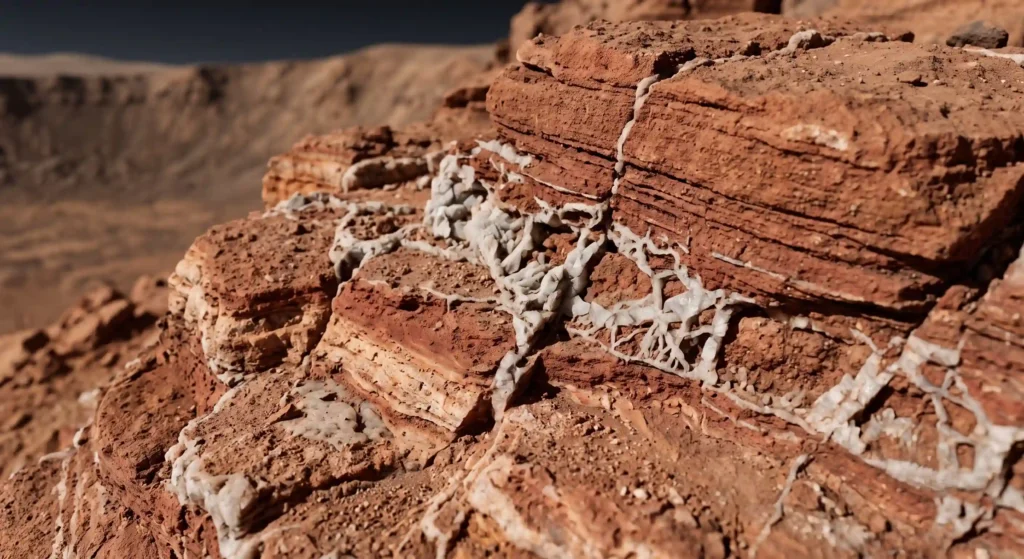
For years this was a strong theoretical prediction with frustratingly little supporting evidence — orbital surveys found far less surface carbonate than the hypothesis required, which was known as the “missing carbonate problem.” Then in 2025, analysis of Curiosity’s drilling in the sulfate-bearing layers of Gale Crater identified substantial iron carbonate, siderite, within the sedimentary rock. It was the ground-truth confirmation that had been missing: the carbonate exists, but buried in sediment rather than exposed at the surface where orbiters could see it.
So the honest answer to “where did the atmosphere go” is that it went two places. Some escaped to space, driven by the loss of the magnetic field and the fury of the young Sun. Some was chemically sequestered into the crust and, without tectonic recycling, never came back. Researchers continue to debate the proportions.
This matters directly for terraforming. Carbon that escaped to space is gone permanently. Carbon locked in rock is, in principle, still on the planet — recoverable by heating the carbonate to drive the CO₂ back out. That would mean processing a substantial fraction of the Martian crust, which is why it appears only in the far-future column of any serious plan.
The Timeline of a Planetary Death
Mars did not die at a moment. Geologists divide its history into three eras, and the transitions between them are the story.
- Noachian (before ~3.7 billion years ago) — the wet world. A functioning dynamo, a thick atmosphere, valley networks, lakes, clay minerals forming in neutral-pH water, and heavy impact bombardment. This is the Mars that would have been habitable, and the era Perseverance’s Jezero Crater samples come from. The dynamo shut down early in this period, starting the clock on everything that followed.
- Hesperian (~3.7 to ~3.0 billion years ago) — the drying. Massive volcanism, catastrophic outflow channels carved by groundwater bursting to the surface, and a decisive shift in the mineral record from clays to sulfates — the chemical signature of water becoming scarce and acidic. The atmosphere was thinning fast under an active young Sun.
- Amazonian (~3.0 billion years ago to today) — the frozen desert. Low erosion rates, minimal water activity, ice migrating between poles and mid-latitudes as the planet’s tilt wobbles. The atmosphere is already thin, and the loss rate has slowed simply because there is so little left to lose.
The critical window is the Noachian–Hesperian boundary. Mars had liquid water on its surface for something like a billion years — comparable to the interval in which life is thought to have emerged on Earth. Whatever happened, or failed to happen, in that window is the single most important open question in the field, and the reason sample return matters so much.
Could We Give Mars an Atmosphere Back?
If the Sun stripped Mars’ air away, could humans put it back? This is the heart of terraforming, and it is the scenario we explore in what if a space mirror melted Mars’ ice caps. The idea would be to release Mars’ frozen carbon dioxide and water to thicken the atmosphere and warm the planet through a greenhouse effect.
The obstacles are immense. First, studies suggest Mars may simply not have enough accessible CO2 left to build a thick, warm atmosphere on its own. Second — and more fundamentally — even if we rebuilt the atmosphere, Mars still has no global magnetic field, so the solar wind would slowly strip it away again. Any new atmosphere would need either constant replenishment or some form of artificial protection, such as a magnetic shield placed between Mars and the Sun. The very thing that killed Mars would keep trying to kill it again. Where that water and ice sit today is covered in our companion piece on liquid water on Mars.
There is one genuinely reassuring detail buried in that objection, and it is usually stated backwards. Stripping an atmosphere takes hundreds of millions to billions of years. On any human timescale — centuries, even millennia — a rebuilt Martian atmosphere would be effectively permanent, and a modest replenishment industry could outpace the leak indefinitely. The magnetic field is a problem for geological time, not for settlement. The genuine blocker is the shortage of carbon dioxide, not its slow escape. How those two constraints stack up against every proposed warming method, and what a realistic sequence actually looks like, is set out in our complete guide to terraforming Mars.
Would an Artificial Magnetic Shield Work?
The most discussed long-term fix, floated by NASA’s Jim Green and colleagues in 2017, is to place a powerful artificial magnetic dipole at the Mars–Sun L1 point, roughly a million kilometres sunward of the planet. The field would deflect the solar wind around Mars in the same way a planetary magnetosphere does, creating an artificial protective bubble downstream.
The modelling was encouraging. With the solar wind held off, Mars would retain outgassed volatiles rather than losing them, and the atmosphere would slowly thicken on its own — the study suggested the planet might rebuild toward roughly half of Earth’s surface pressure over a long period, with average temperatures rising by several degrees.
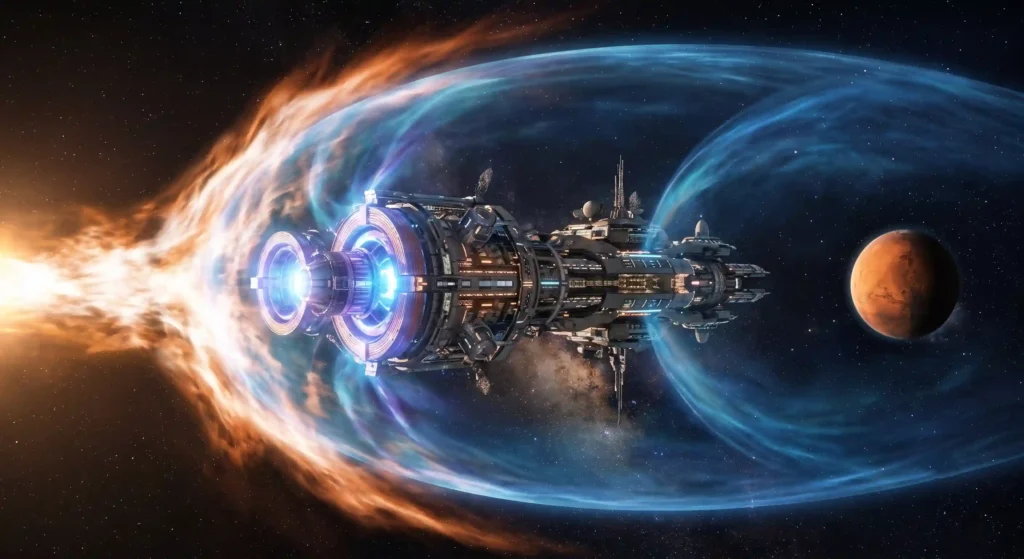
The objections are serious, though. Sustaining a dipole strong enough to stand off the solar wind at planetary scale requires generating and maintaining a magnetic field of a magnitude far beyond any existing engineering, continuously, for centuries. The L1 point is not stable, so the structure would need permanent active station-keeping. And the mechanism only helps if Mars has volatiles left to outgas — it prevents future loss, but it does not create carbon dioxide that is not there.
The concept is best understood as an existence proof rather than a plan: it demonstrates that atmospheric retention is a solvable problem in principle, which matters because it removes the “it would just blow away again” objection from the list of things that make terraforming physically impossible. It moves the problem from the impossible column to the extraordinarily difficult one.
What Mars Teaches Us About Earth
Mars is the clearest demonstration of why Earth’s magnetic field matters. Both planets likely started with atmospheres and water. The crucial difference is that Earth is larger, so its core has stayed hot and molten, keeping the protective magnetic dynamo running for billions of years. That shield, combined with Earth’s stronger gravity, has let our planet hold onto its air and oceans while Mars lost everything.
It is a humbling comparison: the boundary between a living world and a dead one can come down to a planet’s size and the heat in its core. Mars shows what Earth might have become — and reminds us how much we owe to the churning iron beneath our feet.
Venus, Earth, Mars: Three Outcomes
The comparison sharpens considerably when you add the third rocky planet, because Venus breaks the simple story.
- Mars — too small. About 11% of Earth’s mass. Its core cooled quickly, the dynamo failed, and low gravity made escape easy. Result: 0.006 atmospheres and a frozen desert.
- Earth — the narrow path. Large enough to keep a molten, convecting core and a magnetic field; large enough for gravity to hold its air; and — uniquely — possessed of plate tectonics, which recycles carbon between rock and atmosphere and acts as a long-term climate thermostat. Result: 1 atmosphere, liquid oceans, life.
- Venus — too close, and no recycling. Nearly Earth’s twin in size and gravity, yet it has 92 atmospheres of carbon dioxide and a surface at 465 °C. Venus has no significant global magnetic field either, and it still kept a crushing atmosphere. Being nearer the Sun drove a runaway greenhouse; its water vapour rose high, was split by ultraviolet light, and the hydrogen escaped — leaving a deuterium enrichment even more extreme than Mars’. Without tectonic recycling, all its carbon stayed in the air rather than being buried.
Venus is the reason “no magnetic field means no atmosphere” is too simple a rule. Gravity and mass matter more for retention than magnetism does; the magnetic field mainly governs how fast the erosion runs. Mars lost its air because it was small and unshielded and had no way to recycle what went into its rocks. Venus kept far too much for the opposite combination of reasons. Earth sits in the narrow band where size, distance and tectonics all line up — which is a sobering thing to know when assessing how common habitable worlds are likely to be.
Q&A
Not any time soon. Earth’s stronger gravity and its active magnetic field protect our atmosphere from the solar wind. Earth does lose a tiny amount of gas to space, but the rate is negligible, and our atmosphere is safe for billions of years — until the aging Sun eventually changes the picture.
The surface pressure on Mars averages about 0.6% of Earth’s sea-level pressure. That is comparable to the near-vacuum found roughly 35 kilometres above Earth’s surface — far too thin to breathe or to keep liquid water stable.
Not naturally, and not easily. Even ambitious terraforming concepts would take centuries to millennia and face the problem that Mars has little accessible carbon dioxide and no magnetic shield. For the foreseeable future, humans on Mars will need pressurised habitats and oxygen made on site.
Estimates range from centuries to many thousands of years, and all are highly speculative. Warming the planet and thickening the air enough for liquid water might be conceivable over long timescales, but creating breathable, Earth-like air is far beyond any technology we currently possess.
Through isotope ratios. Lighter isotopes escape to space more readily than heavier ones, so long-term atmospheric loss leaves a measurable enrichment in the heavy versions. Mars is enriched in argon-38 over argon-36, in deuterium over ordinary hydrogen by roughly five to six times Earth’s ratio, and in nitrogen-15 over nitrogen-14. Argon is especially conclusive because it is chemically inert and cannot have been removed by reactions with rock.
A process in which heavy ions, accelerated by the solar wind, slam back into the upper atmosphere and physically knock neutral atoms out into space — likened to a cannonball hitting a pool. Unlike thermal escape, sputtering can remove heavy molecules such as carbon dioxide, which is why it matters so much for Mars. MAVEN made the first direct detection of it in 2025, measuring rates over four times higher than models predicted.
No — some was buried. Carbon dioxide dissolved in water reacts with rock to form carbonate minerals, and without plate tectonics Mars had no way to recycle that carbon back into the air. Orbital surveys long struggled to find enough surface carbonate, but in 2025 Curiosity identified substantial iron carbonate (siderite) within Gale Crater sediments, confirming the reservoir exists buried rather than exposed. Researchers still debate the split between space loss and rock burial.
Roughly four billion years ago, early in the Noachian era. Mars is about half Earth’s diameter, so its core cooled far faster; once convection in the molten core weakened, the dynamo generating the global field shut down. Fossil magnetism frozen into the oldest Martian crust is the permanent record that the field once existed.
Because size and gravity matter more for atmospheric retention than magnetism does. Venus is nearly Earth’s twin in mass, so its gravity holds gas far more effectively than Mars’ could. It has no significant global magnetic field yet retains 92 atmospheres of carbon dioxide. Venus shows that a magnetic field governs how fast erosion proceeds, not whether a planet can keep its air at all.
In principle, yes. NASA modelling from 2017 suggested a magnetic dipole stationed at the Mars–Sun L1 point could deflect the solar wind and let the atmosphere slowly rebuild. The obstacles are the sheer field strength required, sustained for centuries, and the need for permanent station-keeping at an unstable point. It also only prevents future loss — it cannot create carbon dioxide that is no longer on the planet.
The Bigger Question
Mars lost its atmosphere because it lost its magnetic shield and its internal heat — a slow death by solar wind. The dream of reversing that, of warming the planet and melting its ice to bring back rivers and air, runs straight into the same physics that killed it. That is the tension at the centre of what if a space mirror melted Mars’ ice caps, where we put the terraforming fantasy to a scientific test.
For more on planetary habitability and humanity’s future in space, explore our Space & Cosmos hub.
Watch the terraforming scenario and see whether we could ever give the Red Planet a second chance.