 By
By 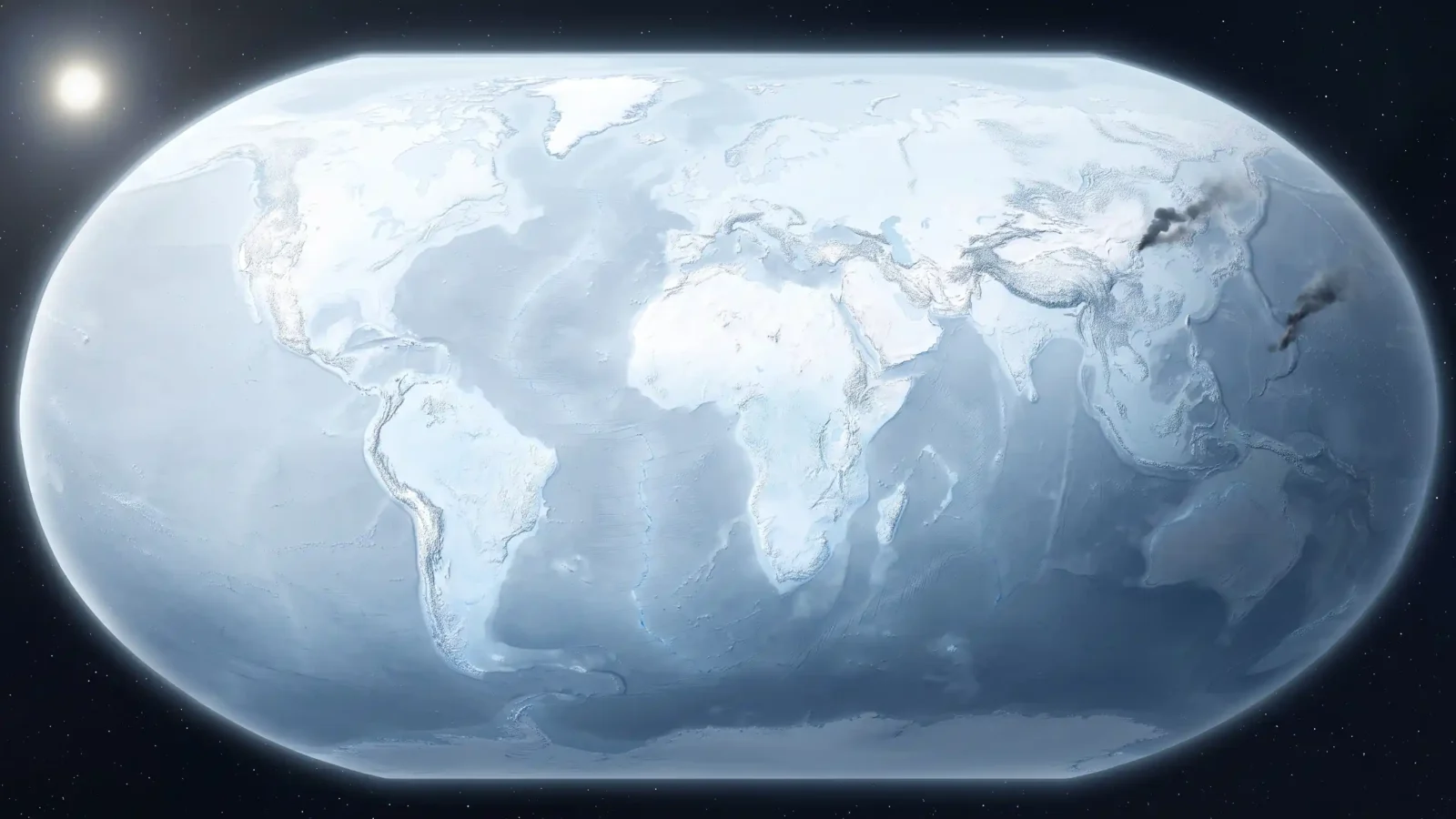
Quick Answer
Snowball Earth is the hypothesis that our planet froze almost completely — from the poles all the way to the equator — during at least two episodes around 700 million years ago. Ice may have covered the entire surface, or nearly all of it, for millions of years. The deep freeze was triggered by a runaway feedback in which ice reflected sunlight and cooled the planet further, and it ended only when volcanic carbon dioxide built up enough to thaw the world.
It is one of the most extreme climate events in Earth’s history: a planet transformed into a giant frozen ball, its oceans capped with ice kilometres thick. Yet life survived, and the recovery may have set the stage for the explosion of complex animals. This guide explains what Snowball Earth was, the evidence locked in ancient rocks, how the whole planet froze, and how it eventually escaped.
What Was Snowball Earth?
Snowball Earth refers to one or more periods, mainly during the Cryogenian period roughly 720 to 635 million years ago, when glaciers and sea ice are thought to have spread across virtually the entire planet. There were at least two major glaciations in this era — known as the Sturtian and Marinoan glaciations — and an even earlier deep freeze around 2.4 billion years ago. During the most severe phases, ice may have reached the tropics and the oceans may have frozen over almost entirely.
Some scientists favour a slightly milder “Slushball Earth” version, in which a band of open or thin ice persisted near the equator. Either way, the planet was vastly colder and icier than anything in recorded human history — a world that, seen from space, would have gleamed white from pole to pole.
The Evidence in the Rocks
The case for Snowball Earth comes from clues preserved in ancient rock formations around the world. The most striking is the discovery of glacial deposits — rock debris dumped by glaciers — in regions that, according to magnetic signatures locked in the rock, were located near the equator at the time. Finding evidence of glaciers in the ancient tropics is hard to explain unless ice had spread across the whole globe.
Other clues reinforce this. Layers of “cap carbonate” rock sit directly atop the glacial deposits, suggesting a sudden, intense warming right after the freeze. Banded iron formations — which require oceans starved of oxygen — reappear in this era, consistent with oceans sealed off from the air by ice. Together, these independent lines of evidence point to a planet that froze and then thawed dramatically.
How the Whole Planet Froze (runaway ice-albedo feedback)
The key to freezing an entire planet is a vicious feedback loop involving reflectivity, or albedo. Ice and snow are bright and reflect a large fraction of incoming sunlight back into space, whereas darker oceans and land absorb it as heat. So when ice spreads, the planet reflects more sunlight, cools further, and grows even more ice.
Normally this is kept in check, but if cooling pushes the ice sheets down to around 30 degrees latitude — roughly the subtropics — the feedback becomes unstoppable. Beyond that tipping point, the reflection of sunlight overwhelms the warming, and ice races all the way to the equator in a geologically rapid runaway freeze. Several factors may have nudged Earth past the brink, including the arrangement of continents near the equator (which weathered rock and pulled down greenhouse gases) and reduced volcanic activity.
How Earth Escaped the Deep Freeze (volcanic CO₂)
If ice reflects so much sunlight, how did Earth ever thaw? The escape came from volcanoes. Even with the surface frozen, volcanic eruptions continued to belch carbon dioxide into the atmosphere. On a normal Earth, that CO2 would be removed over time by rock weathering and absorbed by life — but on a frozen planet, those processes nearly stopped. So the volcanic carbon dioxide had nowhere to go and accumulated for millions of years.
Eventually, CO2 reached extraordinarily high levels, creating a runaway greenhouse effect powerful enough to overcome the ice’s reflectivity. The planet warmed rapidly, the ice melted, and Earth lurched from extreme cold to intense heat — which explains the “cap carbonate” rocks that record a sudden hot, wet aftermath. It was a planetary thermostat operating on a timescale of millions of years.
Could It Happen Again?
A natural Snowball Earth is unlikely today, partly because the Sun is now slightly brighter than it was 700 million years ago and the continents are differently arranged. But the underlying ice-albedo feedback is real, and a sufficiently powerful cooling trigger could in principle restart it.
One intriguing possibility involves events from beyond Earth. If the solar system passed through a dense cloud of interstellar gas and dust, it could dim the sunlight reaching Earth or disturb the protective heliosphere, potentially cooling the climate. That cosmic trigger for a new ice age is exactly the scenario we explore in what if the Earth passed through a dense interstellar cloud. The more familiar, orbital drivers of ice ages are covered in our companion article on Milankovitch cycles.
Snowball Earth and the Explosion of Life
Remarkably, one of the most important consequences of Snowball Earth may have been the flourishing of life. The Cryogenian glaciations were followed by the Ediacaran period and then the Cambrian Explosion — the dramatic diversification of complex, multicellular animals. Many scientists suspect this is no coincidence.
The extreme environmental stress, the dramatic swings in chemistry, and the surge of nutrients and oxygen released as the ice melted may have created powerful evolutionary pressures and opportunities. In this view, the near-death of the planet helped pave the way for the rise of complex life — including, eventually, us. Life had been confined to simple forms for billions of years; it was after the great freezes that animals truly took off.
Q&A
The best-known Snowball Earth episodes occurred during the Cryogenian period, roughly 720 to 635 million years ago, with two major glaciations called the Sturtian and Marinoan. An earlier global glaciation also appears to have taken place around 2.4 billion years ago.
There appear to have been at least two or three major near-global glaciations: the early event around 2.4 billion years ago, and the Sturtian and Marinoan glaciations of the Cryogenian. Earth has also had many milder ice ages that did not freeze the whole planet.
Yes. Life endured in refuges such as hydrothermal vents, hot springs, meltwater pools on the ice, and pockets of open water. The survival and subsequent recovery of life is one reason these events are thought to have spurred the later evolution of complex animals.
It would be catastrophic for civilisation, collapsing agriculture and most ecosystems. Small groups might survive near geothermal heat or in technologically supported habitats, but a full global freeze would be one of the most severe survival challenges humanity could face.
The Bigger Question
Snowball Earth proves our planet can flip into a near-total deep freeze when the climate crosses a tipping point. Most known triggers are earthly — shifting continents, falling greenhouse gases — but what if the push came from space? A passage through a dense interstellar cloud could dim the Sun’s warmth and chill the planet from beyond. That cosmic ice-age trigger is the focus of what if the Earth passed through a dense interstellar cloud.
For the orbital rhythms that pace Earth’s ordinary ice ages, read Milankovitch cycles, and explore more planetary survival scenarios on the Earth & Humanity Survival hub.
Watch the interstellar cloud scenario to see how the cosmos could plunge Earth into ice.