 By
By 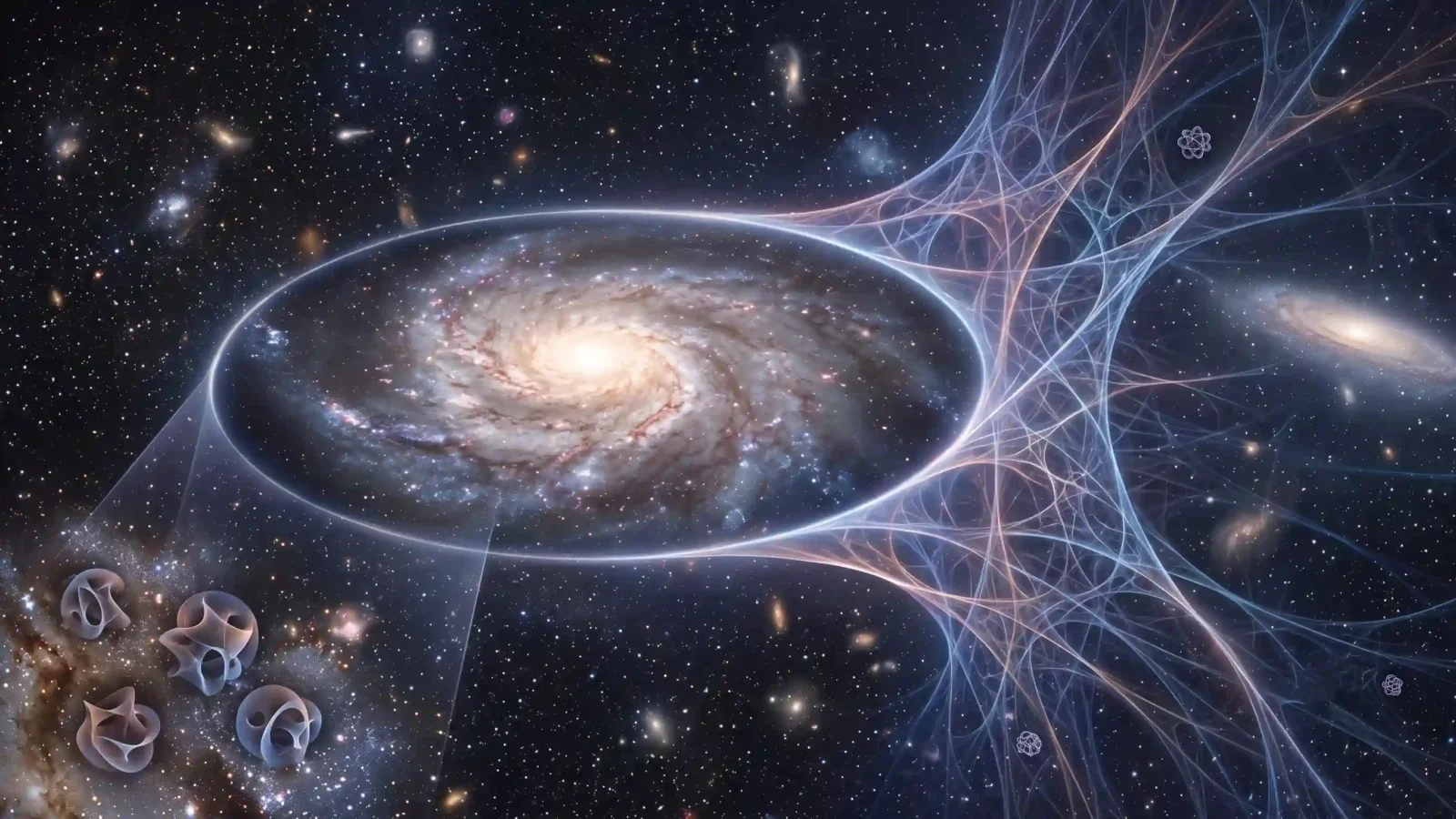
Quick Answer
Extra dimensions are hypothetical dimensions of space beyond the three we experience — length, width, and height. Some of our most ambitious theories of physics, especially string theory, only work mathematically if the universe has more than three spatial dimensions, perhaps as many as ten or eleven in total. If these extra dimensions exist, they are thought to be either curled up far too small to see, or to extend into a higher-dimensional space in which our universe floats like a membrane.
We move through three dimensions of space so naturally that it is hard to imagine more. Yet some of the deepest theories in physics insist that the three we know are not the whole story. This guide explains what dimensions are, why string theory demands extra ones, where they could be hiding, and how scientists might ever hope to detect them.
The Dimensions We Experience
A dimension is simply an independent direction in which you can move. We live in three spatial dimensions: you can move left–right, forward–backward, and up–down. To meet a friend, you specify a location using these three (a street, an avenue, and a floor number), plus one more thing — a time. That makes time a fourth dimension, and physicists combine the three of space and one of time into a single framework called spacetime.
So in everyday physics, we already work with four dimensions: three of space and one of time. The question of “extra dimensions” specifically asks whether there are additional spatial dimensions beyond the familiar three — directions we cannot point to, but that might still shape the laws of nature.
Why String Theory Needs Extra Dimensions
The strongest motivation for extra dimensions comes from string theory, one of the leading candidates for a “theory of everything” that would unite gravity with quantum mechanics. String theory proposes that the fundamental building blocks of nature are not point-like particles but tiny vibrating strings, whose different vibration patterns appear to us as different particles.
The catch is that the mathematics of string theory only becomes consistent if the universe has more than three spatial dimensions. The most common versions require a total of ten dimensions (nine of space and one of time), while the unifying framework known as M-theory requires eleven. These are not arbitrary add-ons — without the extra dimensions, the equations produce nonsense, such as negative probabilities. The dimensions are the price of admission for the theory to work, which is what powers the scenario in what if two braneworlds collided.
Where Are the Hidden Dimensions? (compactification)
If there are six or seven extra spatial dimensions, why do we not notice them? The leading answer is compactification: the idea that the extra dimensions are curled up extremely small, far below anything we can perceive or measure.
A classic analogy is a garden hose. From far away, a hose looks like a one-dimensional line. But up close, you see it actually has a second, curled-up dimension wrapping around its circumference — a tiny dimension you could walk around if you were small enough. In the same way, the extra dimensions of string theory may be wrapped up into incredibly tiny, complex shapes (often called Calabi–Yau manifolds), perhaps near the smallest meaningful size in physics, the Planck length. They would be everywhere, threaded through every point in space, yet far too small to detect directly.
Branes and Higher-Dimensional Space
There is a rival possibility that is even more dramatic. Instead of all the extra dimensions being microscopically small, some theories propose that our entire universe is a three-dimensional surface — a brane (short for membrane) — embedded in a larger, higher-dimensional space, sometimes called the “bulk.”
In these “braneworld” models, the particles and forces we know are stuck to our brane, which is why we only perceive three dimensions. But gravity might be able to “leak” into the extra dimensions of the bulk, which could explain why gravity is so astonishingly weak compared with the other forces. In this picture, other universes could be other branes floating in the bulk, only a tiny distance away in an extra dimension — the seed of the multiverse idea, and the setup for what would happen if two such branes collided.
How We Might Test for Them
Extra dimensions would be a revolutionary discovery, so physicists have looked hard for evidence. The main approaches include:
- Testing gravity at small scales: if gravity leaks into extra dimensions, the law of gravity might deviate from the usual inverse-square rule at sub-millimetre distances. Precise experiments search for such deviations.
- Particle colliders: the Large Hadron Collider has searched for signs of energy “disappearing” into extra dimensions, or for predicted particles such as Kaluza–Klein excitations.
- Microscopic black holes: some braneworld models predicted colliders might briefly create tiny black holes — none have been seen, which constrains the theories.
So far, no experiment has found evidence of extra dimensions, and the results place tight limits on how large any hidden dimensions could be. This does not rule them out — the dimensions could simply be too small for our current instruments — but it keeps the idea firmly in the realm of unconfirmed theory.
Q&A
We directly experience four: three of space and one of time. String theory, however, requires a total of ten dimensions, and the related M-theory requires eleven. The extra spatial dimensions, if they exist, are thought to be hidden — either curled up tiny or extending into a higher-dimensional space.
No. If they exist, they are either curled up far smaller than an atom or accessible only to gravity, making them invisible to our senses and current instruments. We could only detect them indirectly, through subtle effects on gravity or particle physics.
Yes. Time is treated as the fourth dimension, combined with the three spatial dimensions into a single four-dimensional framework called spacetime. It behaves differently from spatial dimensions — we can only move forward through it — but it is a genuine dimension in physics.
We cannot truly picture one, but mathematicians describe shapes like the tesseract — the four-dimensional analogue of a cube. We can only view its “shadow” projected into three dimensions, much as a cube casts a two-dimensional shadow. A true 4D object would be impossible to visualise directly.
The Bigger Question
If our universe really is a membrane floating in a higher-dimensional space, then it is not alone — other universes could be other branes drifting nearby in dimensions we cannot see. And if two of them ever drifted together and collided, the energy released could ignite something as vast as a Big Bang. That is the extraordinary idea behind what if two braneworlds collided.
This connects directly to the broader multiverse and the search for a theory of everything. Explore more cutting-edge physics on the Extreme Physics hub.
Watch the braneworlds scenario to see what hidden dimensions could really be hiding.