 By
By 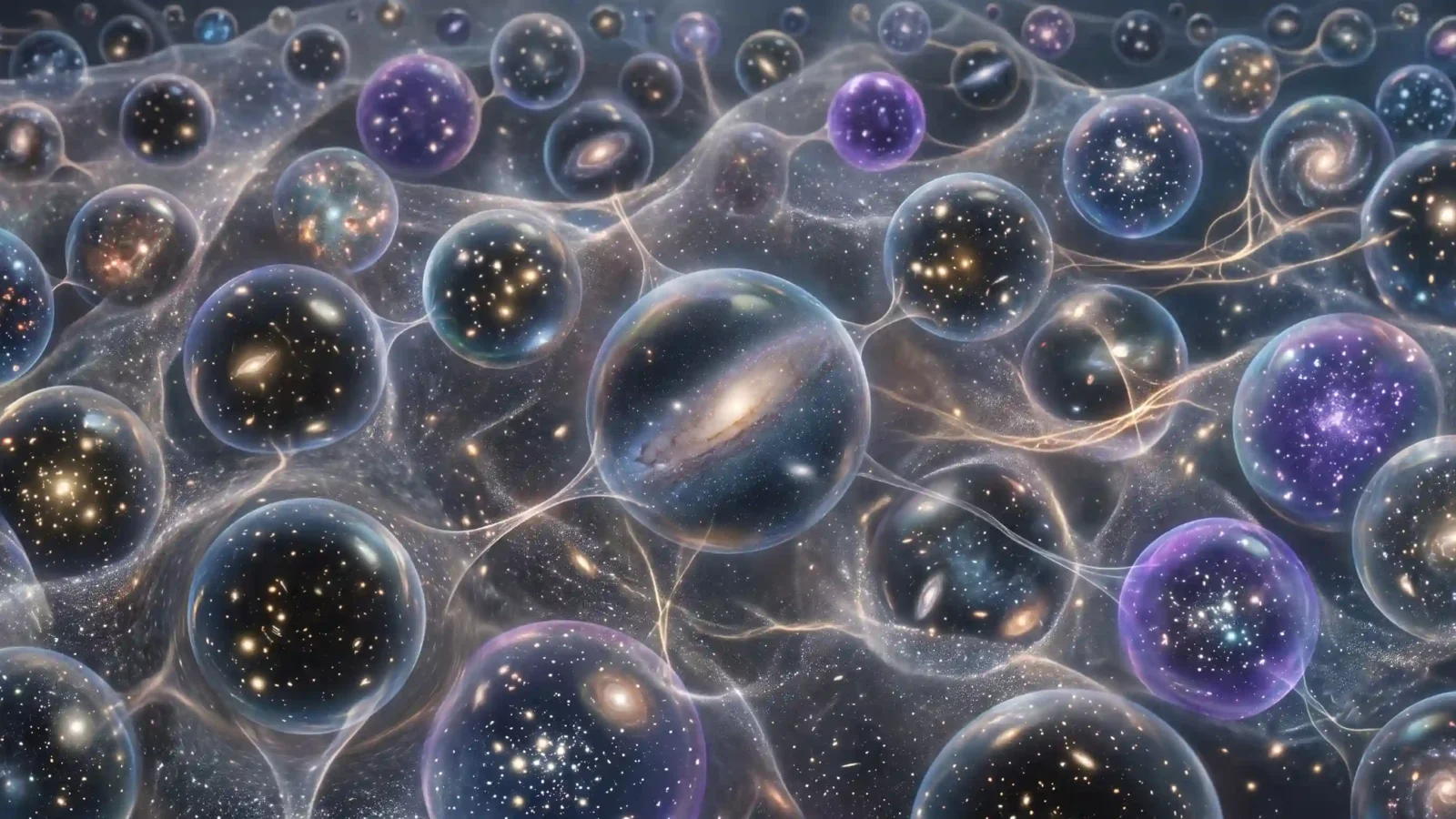
Quick Answer
The multiverse is the hypothesis that our universe is just one of many — possibly infinitely many — universes that exist alongside our own. It is not a single idea but several, arising independently from cosmic inflation, quantum mechanics, and string theory. While the multiverse is taken seriously by many physicists, there is currently no direct evidence for it, and a major debate is whether it can even be tested scientifically at all.
Is our universe everything that exists, or one bubble among countless others? The multiverse is one of the boldest ideas in modern physics — equal parts profound and controversial. This guide explains what the multiverse actually means, the very different theories that lead to it, whether there is any evidence, and the hard question of whether it is science or speculation.
What Is the Multiverse?
The multiverse is the proposal that the universe we observe — all the galaxies, stars, and space we can see — is not the whole of reality, but one of a vast collection of universes. These other universes might have different physical laws, different constants of nature, or simply be separate regions of space far beyond our horizon.
Importantly, the multiverse is not one theory that someone set out to invent. Rather, it keeps emerging as an unintended consequence of several well-motivated theories in physics. When you follow the math of cosmic inflation, quantum mechanics, or string theory to its conclusions, you repeatedly arrive at the possibility of other universes. That is what makes the idea so hard to dismiss — and so hard to confirm.
The Different Types of Multiverse
“The multiverse” actually refers to several distinct ideas, which are often confused. The three most discussed are very different in character.
Inflationary bubbles
Our best theory of the early universe, cosmic inflation, suggests space underwent a burst of exponential expansion just after the Big Bang. Many versions of this theory predict “eternal inflation,” in which inflation never fully stops everywhere — it keeps going in the wider cosmos, constantly spawning new “bubble universes,” each a self-contained cosmos like our own. In this picture, our universe is one bubble in an endlessly inflating sea, and other bubbles could have entirely different physics.
Many-worlds (quantum)
A completely different multiverse comes from quantum mechanics. The “many-worlds interpretation,” proposed by Hugh Everett, suggests that every time a quantum event has multiple possible outcomes, all of them happen — each in its own branching parallel reality. In this view, the universe is constantly splitting into countless versions, one for every possible outcome of every quantum interaction. This is a multiverse of branching histories rather than separate regions of space.
Brane multiverse
The third major idea comes from string theory, which suggests our universe may be a three-dimensional “membrane,” or brane, floating in a higher-dimensional space. Other branes — other universes — could exist parallel to ours, perhaps only a tiny distance away in a dimension we cannot perceive. If two such branes ever collided, the result could be something like a Big Bang. That dramatic possibility is the focus of what if two braneworlds collided, and it relies on the extra dimensions that string theory requires.
Is There Any Evidence?
This is the crux of the matter: there is currently no direct, confirmed evidence for any kind of multiverse. The other universes, by their nature, lie beyond what we can observe — outside our cosmic horizon, in separate quantum branches, or in dimensions we cannot reach.
Some physicists have searched for indirect hints. For example, if our bubble universe had ever collided with a neighbouring one, it might have left a circular imprint in the cosmic microwave background — the afterglow of the Big Bang. Certain anomalies in that background radiation, such as the so-called “Cold Spot,” have occasionally been suggested as possible signatures, but none has held up as convincing evidence. For now, the multiverse remains a theoretical inference, not an observed fact.
Can the Multiverse Even Be Tested?
The deepest objection to the multiverse is philosophical: if we can never observe other universes, is the idea even science? Science traditionally demands that theories make testable, falsifiable predictions. Critics argue that an untestable multiverse is closer to metaphysics than physics.
Defenders respond that the multiverse is not invented for its own sake — it falls out of theories (like inflation) that do make testable predictions about our own universe. If a theory is well-supported in everything we can check, they argue, we should take its other predictions seriously too, even the multiverse. Some also hope for indirect tests, such as the bubble-collision imprints mentioned above. The debate is genuinely unresolved, and it cuts to the heart of what counts as a scientific theory.
What It Would Mean for Us
If the multiverse is real, it could solve one of the biggest mysteries in physics: why the constants of nature seem so finely tuned for life. If there are countless universes with different physical laws, then it is no surprise that we find ourselves in one of the rare universes where life is possible — we could hardly exist anywhere else. This is the “anthropic” argument. Whether that is a profound insight or a way of dodging the question is, again, hotly debated. Either way, the multiverse would mean our entire universe is a single grain of sand on an unimaginably vast beach.
Q&A
We do not know. The multiverse is a serious hypothesis that emerges from several leading theories in physics, but there is no direct evidence that other universes exist. It remains a possibility supported by theory rather than a confirmed feature of reality.
No. No experiment or observation has proven the existence of other universes. Some scientists have searched for indirect signatures, such as imprints of bubble collisions in the cosmic microwave background, but none has been confirmed. Proof may be extremely difficult or even impossible to obtain.
In some versions, yes. If the multiverse is infinite, every possible arrangement of matter — including copies of you — could repeat somewhere. In the many-worlds interpretation, branching versions of you exist in parallel quantum realities. Both ideas are speculative and unproven.
If the multiverse exists, the number could be enormous or even infinite, depending on the type. String theory’s “landscape,” for instance, allows for a famously huge number of possible universes — often quoted as around 10500. Since we cannot observe them, any count is purely theoretical.
The Bigger Question
Of all the multiverse ideas, the brane multiverse offers the most cinematic possibility: that our entire universe is a membrane drifting in higher-dimensional space, and that a collision with another such membrane could ignite a Big Bang. What would actually happen if two of these braneworlds crashed together? That is the spectacular scenario we explore in what if two braneworlds collided.
The idea depends entirely on the hidden extra dimensions predicted by string theory. Dive into more reality-bending physics on the Extreme Physics hub.
Watch the braneworlds scenario to see how a collision between universes could create a cosmos.